Digital Twin Initiative at V. O. Chidambaranar Port
NATIONAL
Why in News:
V. O. Chidambaranar Port has become the first port in India to launch a Digital Twin platform for port management.
The platform was inaugurated on 23 February 2026 by Union Minister Sarbananda Sonowal.
Background
Digital Twin Platform
• A Digital Twin is a real-time virtual replica of physical infrastructure and operations.
• At V. O. Chidambaranar Port, the system digitally replicates:
• Port infrastructure
• Operational assets
• Vessel movements
• Cargo handling operations
• The overall maritime ecosystem
• The platform allows authorities to monitor, analyse and optimise port operations using real-time data and predictive analytics.
UPSC/BPSC
Dhwani Spandana System – KSRTC
NATIONAL
Why in News:
The Karnataka State Road Transport Corporation (KSRTC) has received the Governance Now 12th PSU National Award in the “Excellence in Innovation” category for its initiative “Dhwani Spandana.”
Background
Dhwani Spandana System
• Dhwani Spandana – Onboard Bus Identification and Navigation System is an assistive technology developed by KSRTC.
• It provides audio-based guidance for visually impaired passengers.
• The system helps passengers identify the correct bus and board it safely without assistance from others.
• It improves accessibility and safety in public transport.
UPSC/BPSC
Bim10 Corruption Case
INTERNATIONAL
Why in News:
International cricketers Javon Searles, Trevon Griffith, and Chitranjan Rathod have been provisionally suspended in connection with the Bim10 corruption case.
Key Highlights
• The suspension was announced jointly by the International Cricket Council (ICC) and Cricket West Indies (CWI).
• The charges relate to alleged violations of anti-corruption regulations.
• The incidents are linked to the 2023–24 Bim10 tournament held in Barbados.
Background
Bim10 Tournament
• Bim10 is a T10 cricket tournament held in Barbados.
• The league features international and domestic players and is organized to promote short-format cricket in the Caribbean.
• The tournament falls under ICC anti-corruption regulations, which prohibit activities such as match-fixing, spot-fixing, and misuse of inside information.
UPSC/BPSC
LIGO-India Project
NATIONAL
Why in News:
India’s Laser Interferometer Gravitational Wave Observatory (LIGO-India) project in Hingoli district, Maharashtra is facing implementation delays, raising concerns about its timeline, although officials maintain that the project will be completed by 2030.
Background
LIGO-India Project
• LIGO-India is designed to detect gravitational waves, which are ripples in space-time caused by massive cosmic events such as black hole or neutron star collisions.
Lead Agencies and Collaboration
• The project is jointly led by the Department of Atomic Energy (DAE) and the Department of Science and Technology (DST).
• It will operate in collaboration with the global LIGO network, including observatories in the United States.
UPSC/BPSC
White Phosphorus Use in Israel–Lebanon Conflict
INTERNATIONAL
Why in News:
A report by Human Rights Watch has accused Israel of using white phosphorus munitions in residential areas of Lebanon, raising concerns about possible violations of international humanitarian law.
Background
White Phosphorus
• White phosphorus is a toxic, wax-like chemical substance.
• It ignites when exposed to oxygen and burns at temperatures above 800°C.
• The substance burns intensely enough to melt metal and cause severe burns on contact.
• In military use, it is commonly used for smoke screens, illumination, and incendiary purposes.
UPSC/BPSC
India and IEA Strategic Oil Release
NATIONAL
Why in News:
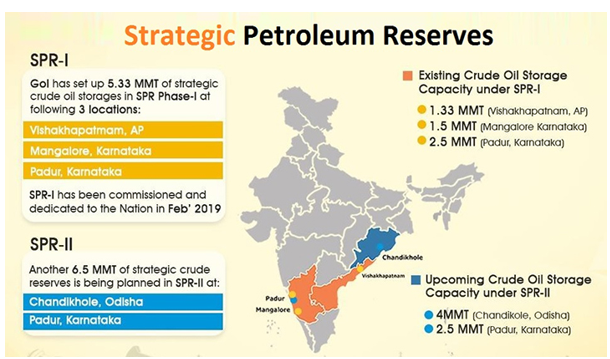
India has decided not to participate in the International Energy Agency’s (IEA) coordinated release of Strategic Petroleum Reserves (SPRs), which was proposed to stabilize global oil markets amid escalating Middle East tensions.
Background
Rationale for India’s Decision
• The government followed an “India First” energy security approach.
• India stated that strategic petroleum reserves are meant only for domestic emergencies.
• They are intended to protect the country from actual supply disruptions, not to stabilize global oil prices.
Strategic Petroleum Reserves (SPR)
• Strategic Petroleum Reserves are emergency crude oil stockpiles maintained by governments.
• These reserves are used to ensure energy security during supply disruptions or crises.
India and IEA Membership
• India is not a full member of the International Energy Agency (IEA).
• It participates as an associate member.
• Therefore, India has no binding obligation to follow IEA decisions on coordinated oil reserve releases.
International Energy Agency (IEA)
• Established: 1974
• Headquarters: Paris, France
• Parent Organization: Organisation for Economic Co-operation and Development
• IEA was created after the 1973 Oil Crisis
UPSC/BPSC
No-Fault Liability Compensation for Covid-19 Vaccine Adverse Effects
NATIONAL
Why in News:
The Supreme Court of India has directed the Union Government to formulate a “no-fault liability” compensation policy for individuals who suffered serious adverse effects or deaths following the Covid-19 vaccination drive.
Key Highlights
No-Fault Liability Principle
• The Supreme Court invoked the principle of no-fault liability.
• Under this principle, victims or their families can receive compensation without proving negligence or wrongdoing by vaccine manufacturers or the government.
• This concept already exists in Indian law, for example in motor vehicle accident compensation cases.
• Similar vaccine injury compensation systems exist in countries such as Australia, the United Kingdom and Japan.
State’s Constitutional Responsibility
• The Court relied on Article 21 of the Constitution (Right to Life), which includes the right to health and dignity.
• It stated that the State has a positive obligation to protect citizens’ welfare.
• According to the Court, the Constitution envisions the State as an “active guardian of welfare and dignity” rather than a passive observer.
UPSC/BPSC
Black Rain
INTERNATIONAL
Why in News:
Residents of Tehran, Iran reported the occurrence of “black rain” after Israeli strikes on Iranian oil facilities triggered large fires, raising concerns about environmental pollution and public health risks.
Key Highlights
• The phenomenon occurred after oil facility fires released large amounts of soot and pollutants into the atmosphere.
• As rain fell, it mixed with these airborne pollutants, resulting in dark, oily rainfall.
• The World Health Organization (WHO) has warned that such contaminated rain can pose serious health risks, particularly to the respiratory system.
Background
Black Rain
• Black rain refers to rainfall contaminated with soot, ash, oil particles and industrial chemicals released into the atmosphere from large fires or industrial accidents.
• As raindrops fall through polluted air, they absorb these particles, making the rain dark or oily in appearance.
UPSC/BPSC
Creamy Layer in OBC Reservation – Supreme Court Judgment (2026)
NATIONAL
Why in News:
The Supreme Court of India has ruled that parental income alone cannot determine the “creamy layer” status of Other Backward Classes (OBC) candidates, clarifying the criteria used in civil services reservation rules.
Key Highlights
Quashing the 2004 Clarificatory Letter
• The judgment resolves confusion between the 1993 Office Memorandum (OM) of the Department of Personnel and Training (DoPT) and a 2004 clarificatory letter.
• The 1993 DoPT OM stated that income from salaries and agricultural land should not be counted while determining the creamy layer.
• However, the 2004 clarification included salary income of PSU and private sector employees, creating unequal treatment.
Status-Based, Not Purely Income-Based
• The Supreme Court clarified that creamy layer determination is primarily status-based, not only income-based.
• It should consider the parent’s employment category and post status (Group A, B, C, or D) instead of relying solely on income levels.
Constitutional Validity
• The Court held that the earlier approach resulted in “hostile discrimination.”
• Children of government employees with lower-level posts could retain OBC benefits even if salaries increased.
• Meanwhile, children of PSU or private sector employees were excluded once parental income crossed ₹8 lakh, creating unequal treatment.
• This violated Articles 14, 15 and 16 of the Constitution, which guarantee equality before law and equal opportunity.
Relief for PSU and Private Sector Employees
• The judgment may expand eligibility for OBC reservation, particularly for children of PSU employees and private sector workers.
• The Court directed the government to create supernumerary posts if necessary to accommodate candidates who were wrongly excluded earlier.
Background
Creamy Layer Concept
• The concept of “creamy layer” was introduced in the 1992 Indra Sawhney vs Union of India case.
• It aims to exclude socially and economically advanced OBC members from reservation benefits.
Existing Rules
• Children of Group A officers or those promoted to Group A before the age of 40 are treated as creamy layer.
• Children of two Group B officers are also classified as creamy layer.
• For non-government occupations, the income limit for creamy layer is ₹8 lakh per year (since 2017).
UPSC/BPSC
Mains News
Harish Rana vs Union of India Case (2026) – Passive Euthanasia
NATIONAL
Why in News:
The Supreme Court of India, in the Harish Rana vs Union of India Case (2026), permitted passive euthanasia by allowing withdrawal of life support.
This marks the first application of the 2018 Common Cause judgment, which recognized the right to die with dignity under Article 21.
Key Highlights
About the Case
• Harish Rana, a 19-year-old student from Chandigarh, suffered a severe accident in August 2013 after falling from a fourth-floor building.
• The accident caused catastrophic brain injuries, leaving him in a Permanent Vegetative State (PVS) with 100% quadriplegia (paralysis of all four limbs).
• For nearly 13 years, he survived only through Clinically Assisted Nutrition and Hydration (CANH) delivered via PEG tubes.
• The Delhi High Court dismissed the family’s plea in 2024, after which the case was taken to the Supreme Court, which allowed passive euthanasia.
Key Observations of the Supreme Court
Acceptance of Medical Boards’ Recommendations
• The Court accepted the unanimous recommendation of medical boards and the family to withdraw life support.
• It directed AIIMS, New Delhi to admit Harish Rana to its palliative care department and create a comprehensive end-of-life care plan.
• The Court emphasized that the process must be carried out humanely while managing pain and symptoms, ensuring the patient’s dignity.
Waiver of Reconsideration Period
• The Court waived the standard 30-day reconsideration period to avoid further suffering.
• This allowed immediate implementation of the medical boards’ decision to withdraw CANH.
Background
Euthanasia
• Euthanasia is the intentional act of ending a person’s life to relieve unbearable suffering caused by severe or incurable illness.
• The term originates from Greek words “eu” (good) and “thanatos” (death) meaning “good death.”
Types of Euthanasia
Active Euthanasia
• A deliberate action to cause death, such as administering a lethal injection.
Passive Euthanasia
• Withholding or withdrawing life-sustaining treatment, allowing the patient to die naturally.
Based on Consent
Voluntary
• Done with the explicit consent of the patient.
Non-Voluntary
• Done when the patient is unable to provide consent (for example, coma or vegetative state).
Involuntary
• Done without the patient’s consent, which is widely illegal.
Legal Framework in India
• Active euthanasia remains illegal in India under the Bharatiya Nyaya Sanhita (BNS), 2023.
• Intentionally causing death may be treated as an offence under:
• Section 100 – Culpable Homicide
• Section 101 – Murder
• However, the Supreme Court legalized passive euthanasia in the Common Cause vs Union of India (2018) case by recognizing the right to die with dignity under Article 21.
Legal Procedure for Passive Euthanasia
The Supreme Court guidelines (2018, modified in 2023) establish a two-stage medical review process:
Primary Medical Board
• Formed by the hospital.
• Includes the treating physician and two independent doctors with at least 5 years of experience.
Secondary Medical Board
• Consists of three independent doctors from a panel maintained by the District Medical Officer.
• Reviews the decision of the primary board.
• Both boards should give their opinion within 48 hours.
• The decision must be communicated to the Judicial Magistrate First Class (JMFC) along with family consent.
Global Perspective
• Netherlands allows both active euthanasia and assisted suicide.
• Switzerland permits assisted suicide only.
• Italy allows passive euthanasia.
UPSC/BPSC
One Liner News
FACTUAL
1. Razorpay has launched an AI-powered Agent Studio platform built on Claude AI technology to automate payment operations, where AI agents will manage tasks such as handling disputes and streamlining payment processes.
2. N. Chandrababu Naidu launched ‘Araku Kouni’, Andhra Pradesh’s first tribal millet-based food menu, during the Collectors’ Conference at the State Secretariat, featuring authentic tribal millet recipes sourced from indigenous communities of Alluri Sitarama Raju district.
3.The International Rail Coach Expo (IRCE) 2026 was inaugurated on 12 March 2026 at the grounds of the Integral Coach Factory in Chennai, and the event was inaugurated by U. Subba Rao, General Manager of the Integral Coach Factory.
4.Droupadi Murmu addressed the Global Conference on Women in Agri-Food Systems (GCWAS-2026) in New Delhi, emphasizing the need for greater leadership, policy participation and empowerment of women farmers to build inclusive agricultural systems.
5.Perplexity AI has launched Personal Computer, an AI agent capable of researching topics, writing emails, managing files and automating tasks across devices.
6.Savitribai Phule
Savitribai Phule was remembered by the Amit Shah on 10 March, her death anniversary, highlighting her role in promoting women’s education during a period marked by deep social evils.
• She was a 19th-century social reformer from Maharashtra who worked to challenge patriarchal and caste hierarchies and promote education for women and marginalized communities.
• She was born on 3 January 1831 in Naigaon, Maharashtra.
7. The National Highways Authority of India has released the first Annual Report on the National Highways Green Cover Index (NH-GCI) 2025–26, prepared in collaboration with National Remote Sensing Centre.
UPSC/BPSC

Copyright © 2025 Padhai Marg. All Rights Reserved
Designed by : Brightcode Software Services